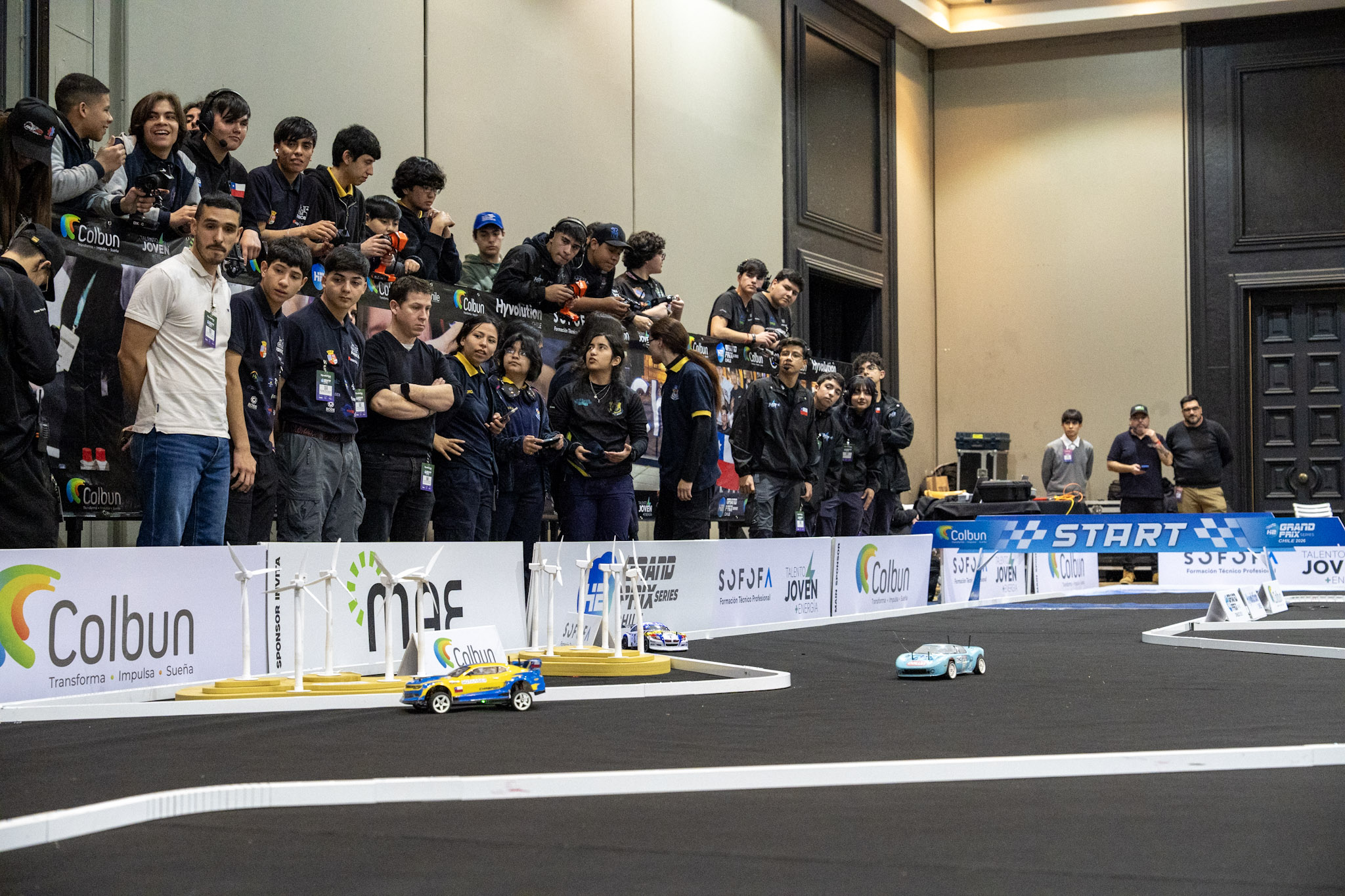
With scale model cars powered by fuel cells, the school competition began its trials at Metropolitan Santiago. Ximena Rincón emphasized the urgent need to train the human capital required by the industry in a timely manner.
With the checkered flag raised and the expectant murmur of dozens of young people gathered at the edge of the track, Energy Minister Ximena Rincón started the competitive phase of the H2 Grand Prix (H2GP) at the opening of Hyvolution 2026. The ceremonial gesture lasted only a few seconds, but unleashed the electric hum of tiny scale model cars that, within their reduced chassis, conceal cutting-edge engineering.
The qualifying rounds and the highly anticipated endurance race will take place this Wednesday, September 2nd, at the Metropolitan Santiago track. It is a grueling four-hour test where speed takes a backseat to endurance.
Each car in the competition is powered by a 30-watt PEM fuel cell composed of 14 cells that mix hydrogen with oxygen from the air through an electrochemical reaction; the released electrons travel through a circuit that propels the wheels, with water being the only byproduct. During the race, while the fuel cell delivers a constant base of power, the batteries and supercapacitors absorb the stress of sudden accelerations.
Thus, each team must operate like an engineering department, producing its own fuel from distilled water and electricity using HydroFill benchtop electrolyzers, and storing the gas in solid form in secure metal hydride cylinders.
Anticipating Talent
Minutes after the checkered flag dropped and she observed the work of the school racing teams in the pits, Minister Rincón elaborated on the strategic importance of involving new generations in these developments early on. She stated, “There is an area where we cannot wait idly for the market to mature, because training a person takes years: human capital. The same capital we were just seeing with our young people”, she emphasized.
Rincón reviewed some of the strengthening plans the government is implementing in this area. “That’s why we’ve reinforced the human capital office for energy. Together with the University of Magallanes and the Catholic University of the Holy Conception, we’ve developed training programs and a job training model with new career paths based on the real needs of the industry. And we already have 24 certifiable job profiles in partnership with Chile Valora and the Chilean-German Chamber of Commerce”.