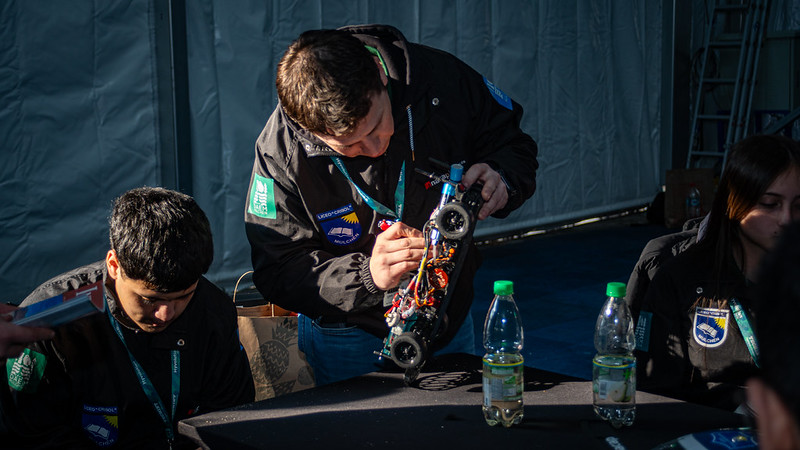
As part of Hyvolution, 23 school and university teams will test scale models powered by fuel cells in a demanding endurance test where the key is not just to accelerate, but to manage every gram of hydrogen.
The roar of electric motors and the tension of an endurance race will take over Hyvolution with a competition that transforms the track into a moving laboratory. The H2 Grand Prix Pro, a program by Horizon Educational, brings together 23 teams from technical high schools and universities around small hydrogen-powered vehicles, designed, built, and managed by the students themselves. In this competition, acceleration is secondary; each lap demands an understanding of energy, efficiency, and strategy.
The teams receive a radio-controlled car, approximately one-tenth the size of the actual vehicle, equipped with a chassis, motors, power electronics, and a fuel cell. Its logic is similar to that of hydrogen vehicles like the Toyota Mirai or the BMW iX5 Hydrogen: the fuel cell delivers constant energy, while the battery and supercapacitors respond to the peak demands that arise during acceleration. At its core operates a 30-watt PEM (proton exchange membrane) fuel cell, made up of 14 cells that combine hydrogen and oxygen from the air through an electrochemical reaction. Electrons travel through an external circuit and power the vehicle; the only byproduct is water.
The experience doesn’t stop at the car, as each team also has a HydroFill, a benchtop electrolyzer that produces hydrogen from electricity and distilled water. Students separate the water into hydrogen and oxygen through electrolysis and then observe the reverse reaction inside the fuel cell, where the hydrogen is converted back into electricity. The fuel is stored in metal hydride cylinders, a compact and safe technology that keeps hydrogen in a solid state at low pressure. It’s so safe that it’s even suitable for air transport under IATA regulations.
This combination transforms each team in the competition into a small energy engineering department. They have to decide where to install the fuel cell and the cylinder to balance the vehicle’s weight, review the aerodynamics, manage the power between the fuel cell, battery, and supercapacitors, and carefully conserve every gram of hydrogen available. All these solutions are put to the test during the competition itself, with stopwatches, curves, and decisions that can change the outcome.
For Carola Fuentes, general manager of FISA, the presence of these racing teams gives the event a distinctive character. “Seeing these young people in action brings a dynamic and fresh energy to the fair. They have an innate sensitivity and a very genuine commitment to clean energy, and providing them with a space like Hyvolution opens a direct door to the industrial ecosystem. It is here that they demonstrate that their technical talent and ideas, applied in practice, play a leading role in the future”. the executive emphasizes.
The H2 Grand Prix Pro includes four categories: Stock, which opens the door with standardized components; Modified, which allows for unrestricted redesign of the car; Hybrid, which combines fuel cells, batteries, and supercapacitors; and Prototype, which challenges the most advanced teams to race exclusively on hydrogen, without battery backup. The jury considers both the vehicle’s engineering (including its design, technical documentation, and safety inspection) and its actual performance on the track.
To give you an idea, the main event brings the spirit of the 24 Hours of Le Mans to a concentrated scale: four hours of continuous racing. The winner isn’t the one who completes the fastest lap, but rather the one who completes the most laps within that time. And just like in the major speed trials, the cars must pit to refuel with hydrogen using the HydroFill system. What makes this race exciting is that each pit stop presents a dilemma. A very fast, but fuel-hungry, vehicle can lose positions due to the frequency of its stops, while a more efficient one can advance less spectacularly and ultimately prevail through consistency.
That’s where the appeal of the H2 Grand Prix Pro lies: under the guise of a scaled-down car race, participants face real-world challenges in clean mobility and real-time energy management. At Hyvolution, this competition will showcase the technical talent required for the energy transition: young people capable of translating scientific knowledge into design decisions that prioritize efficiency and speed.