Hyvolution Chile 2026 defines its roadmap: International Congress will address the commercial, financial and regulatory keys to clean energy
The global race for decarbonization and the development of clean energy will have its epicenter in Santiago with the return of Hyvolution Chile 2026, the most important event in the sector in the region, whose honorary president is the Minister of Energy, Ximena Rincón.
Between September 1 and 3, the Metropolitan Santiago event center will bring together the main players in the green hydrogen, sustainable mobility, and energy storage industries for an international congress chaired by former Minister Vivianne Blanlot, who is currently a director at Colbún. Organized by Fisa and GL events, in co-organization with H2 Chile, the event is positioned as a crucial forum for discussing the future of clean energy and its real impact on the economy.
The opening day on Tuesday, September 1st, will begin early with Panel 1, scheduled between 9:30 and 10:30 a.m., which will address energy security and competitiveness through the progress of clean energy projects and initiatives in Chile and globally. Following this initial analysis, the Hyvolution Opening Ceremony will take place at 11:00 a.m.
The afternoon session will begin at 12:30 p.m. with Panel 2, a forum to understand the Government’s vision for resuming economic growth and energy resilience through strategic investments. Subsequently, between 2:30 and 3:30 p.m., Panel 3 will present the proposed strategic path to accelerate investment in Chile from the perspective of industry associations. The first day of discussions will conclude with Panel 4, scheduled from 3:45 p.m. to 4:45 p.m., focusing on strategies to stimulate local demand for green hydrogen and its derivatives with the aim of consolidating a national market.
On Wednesday, September 2, the event will begin at 9:00 a.m. with Panel 5, which will delve into the main challenge for finalizing the industry’s business case: securing offtakers. At 10:00 a.m., the first keynote address will analyze the international energy landscape and the role of Asia, evaluating the opportunities and challenges that lie ahead for Chile. Immediately following, at 10:30 a.m., the keynote address “Ports of Tomorrow: Green Maritime Corridors in Chile” will take place, marking the official launch of the joint study between Chile and South Korea. At 11:15 a.m. a simultaneous debate space will open: on the one hand, Panel 6 will examine the geopolitics of the energy transition, security, power and the new global balances.
In that same block, and at times to be confirmed, two side events will take place: one focusing on Latin America’s perspective on industry development and the other on the “Women in Hydrogen” meeting.
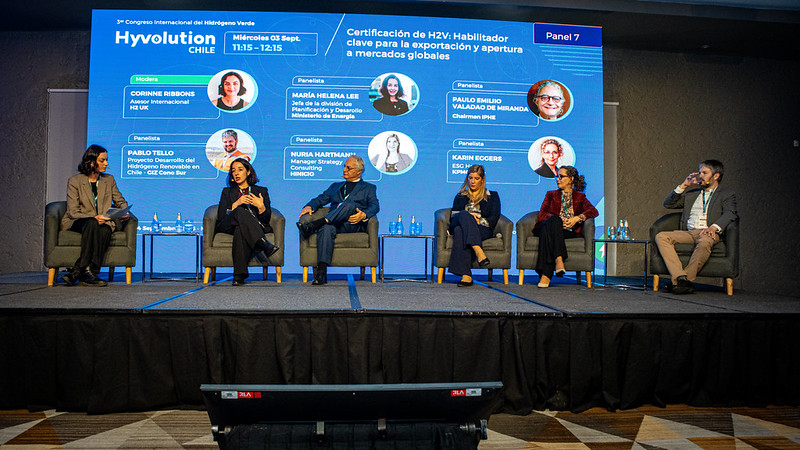
Wednesday afternoon will continue to diversify the technical and financial discussion. Between 12:30 and 1:30 p.m., Panel 7 will review the emerging role of e-methanol in the field of alternative fuels and drop-in fuels. After a break, at 2:30 p.m., Panel 8 will take up the agenda to discuss green ammonia as an engine for the transition and a sustainable alternative for various commercial sectors. Financing and technical feasibility will be the focus of the second day’s closing discussions. First, from 3:45 to 4:45 p.m., Panel 9 will break down the mechanisms and solutions for closing the financing gap for the International Development Fund (IDF). Finally, between 5:00 and 6:00 p.m., Panel 10 will address the regulatory challenges of green hydrogen and its derivatives, highlighting the keys to unlocking commercial-scale projects.
The closing of the congress, scheduled for Thursday, September 3, will focus on the regional aspects and the latest scientific advances. Panel 11, which will take place between 10:00 and 11:00 a.m., will address the sustainable development of projects in the regions, a session centered on reviewing lessons learned and community best practices. At 11:15 a.m., Panel 12 will address the use of green hydrogen and e-fuels in aviation and shipping, analyzing the technologies available for those productive sectors that are traditionally difficult to address. After midday, from 12:30 to 1:30 p.m., Panel 13 will review international experiences of projects that are already successfully progressing from planning to actual implementation. The summit will conclude with Panel 14, between 2:30 and 3:30 p.m., with a comprehensive review of advances in research, development, and innovation on hydrogen and its derivatives, both in Chile and around the world.