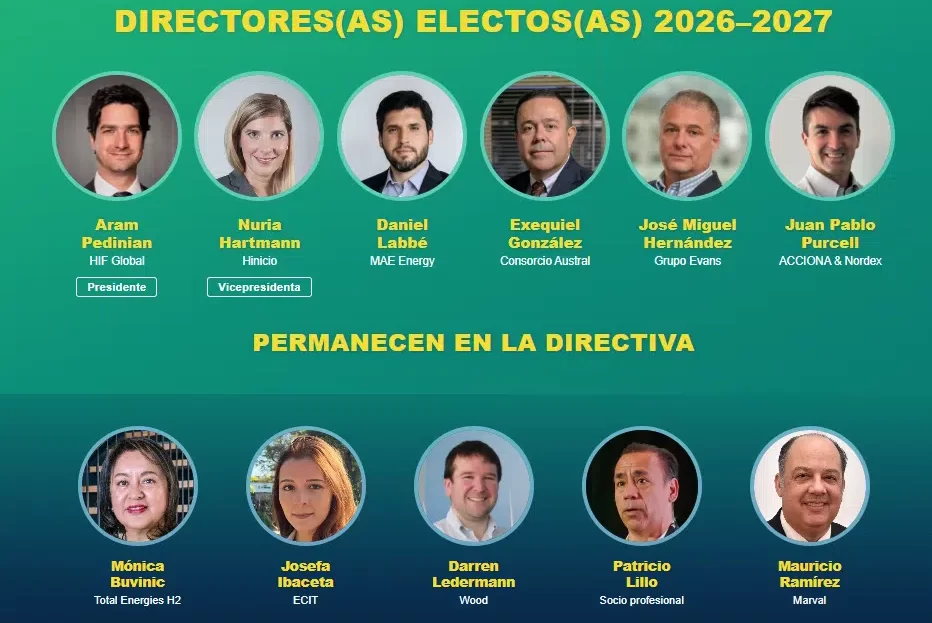
During its Tenth Ordinary General Meeting of Members, the Chilean Hydrogen Association, co-organizers of Hyvolution, elected its new board of directors for the 2026-2027 term. This event marks a turning point for accelerating investments, fostering local demand, and strengthening the country’s energy security.
The Chilean Hydrogen Association, H2 Chile, announced the formation of its new board of directors. This change marks the beginning of a strategic phase for the association, whose focus will be on making the definitive leap from planning to the implementation of large-scale projects and strengthening Chile’s energy sovereignty.
For the 2026-2027 period, the board will be headed by Aram Pedinian (HIF Global) as president and Nuria Hartmann (HINICIO) as vice president. They are joined by directors Exequiel González (Consorcio Austral), Juan Pablo Purcell (ACCIONA & Nordex Green Hydrogen), José Miguel Hernandez (Grupo Evans), and Daniel Labbé (MAE).
This new board combines experience with expertise in the development of concrete projects both in Chile and abroad.
Energy Security in the Face of Global Volatility
The transition of leadership at H2 Chile is taking place in a complex international context, where market volatility has once again placed energy independence at the center of the debate.
During the assembly, the association’s Executive Director, Marcos Kulka, emphasized how rising oil prices highlight Chile’s vulnerability given its dependence on imported fossil fuels.
“In this context, hydrogen and its derivatives are no longer just a decarbonization strategy but have become a strategic opportunity for energy security and productive development”, Kulka stated. “Chile has unique conditions: world-class renewable resources and available territory outside of armed conflict zones”.
The executive also warned that this window of opportunity requires immediate action: accelerating permit processing, providing regulatory certainty, and developing robust logistics infrastructure for derivatives such as ammonia and synthetic fuels.
Challenges for 2026-2027
The Assembly also served as a platform to review the outgoing administration’s performance, a period in which H2 Chile consolidated its position as a key player both nationally and internationally. Highlights of the past year included progress in critical regulatory matters and the consolidation of an attractive project portfolio, with initiatives already operational and others that have secured their Environmental Qualification Resolution (RCA).
The Association took the opportunity to thank the outgoing board, comprised of Rebeca Poleo (former president), Grace Keller (former vice president), and directors Juan Andrés Camus, Juan Pablo Fiedler, and Rubén Pérez. Their leadership was vital in positioning green hydrogen as an engine of sustainable development and establishing the industry’s technical foundation.
Looking ahead to the 2026-2027 cycle, the new board’s main challenge will be to move decisively forward with implementation. The goal is to boost local demand in strategic and energy-intensive sectors such as heavy transport, mining, and the national manufacturing industry.
With a diverse perspective, both territorial and technical, H2 Chile assumes the mandate to transform the country’s current energy dependence into a long-term competitive advantage, seeking to consolidate Chile’s position as an undisputed leader in global clean energy markets.