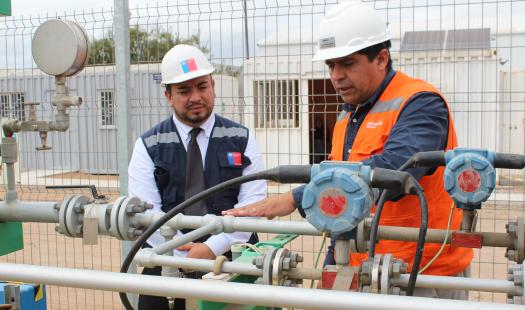
Chile is moving towards decarbonization with pioneering green hydrogen projects, such as Gas Valpo in Coquimbo, a technology that will be a central part of the debate at Hyvolution Chile, the fair that promotes the country’s energy transition.
In a milestone for Chile’s energy transition, Gas Valpo has achieved a 10% injection of green hydrogen into the natural gas networks supplying more than 4,600 families in La Serena and Coquimbo, consolidating the first experience of its kind in South America. The project aims to demonstrate the viability of domestic use of this clean energy source and its direct contribution to reducing CO₂ emissions.
The initiative was visited by the Regional Secretary of Energy, Fabián Páez, who praised the technological advancement and its contribution to the country’s decarbonization goals. “This plant is an example of innovation applied to residential consumption. It is an investment that not only reduces the carbon footprint but also helps stabilize gas costs for families,” stated the regional authority.
The system began with an initial blend of 3.5% hydrogen and, after the addition of an electrolyzer—a device that separates hydrogen (H₂) from oxygen (O) using water—the percentage was progressively increased to the current 10%. The goal for this year is to reach an injection of 15%, with a final target of 20%. If achieved, annual reductions of up to 340 tons of CO₂ are estimated.
From Gas Valpo, the zonal and project manager, Jorge Briceño, highlighted the impact of the initiative: “We are proud to be pioneers in the production and injection of green hydrogen for residential use. This cleaner gas directly contributes to reducing emissions during combustion and improves air quality in the region”.
The project has the technical support of the Faculty of Engineering at the University of La Serena, which verifies the compatibility of green hydrogen with the materials used in the network and household appliances, as well as monitoring combustion quality. It is worth noting that users do not perceive any difference in the use of their stoves or water heaters, nor any variations in their utility bills.
With this development, the Coquimbo Region reinforces its leadership in renewable energy and positions itself as a key area for the production and application of green hydrogen in Chile.
This type of advancement will be a central topic of discussion at the upcoming Hyvolution Chile trade fair, an international event specializing in renewable energy and sustainable mobility, which will bring together leading companies, experts, and authorities in the sector to promote the country’s energy transformation.