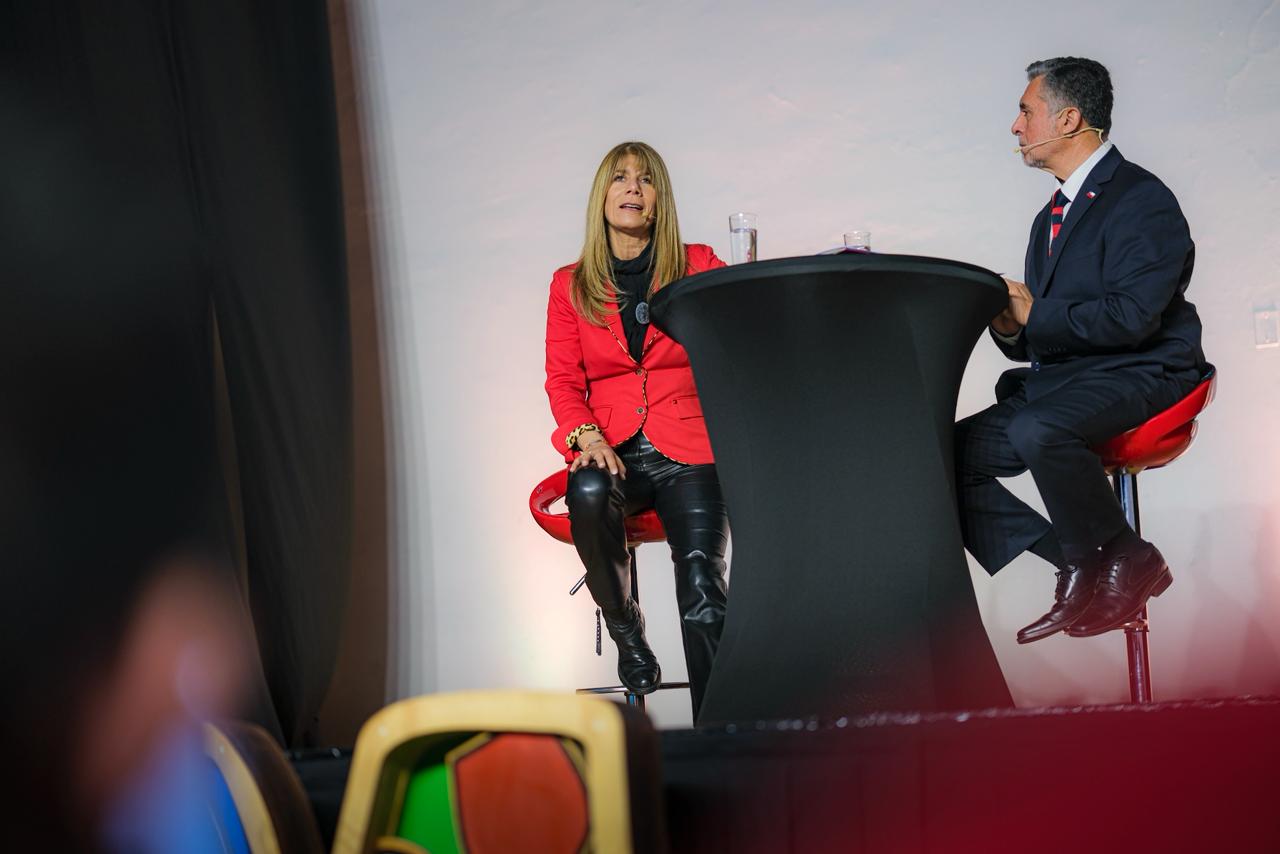
At the event led by Minister Ximena Rincón, honorary president of Hyvolution, authorities highlighted key decarbonization milestones such as the thermoelectric conversion of Tocopilla and the unlocking of more than 6.2 billion dollars in investment for projects in the sector.
The municipality of Molina was chosen by the Ministry of Energy to host the 2025-2026 Participatory Public Accountability Report. Held at the municipal theater in this Maule town, Energy Minister and Honorary President of Hyvolution, Ximena Rincón, along with Undersecretary Hugo Briones, led a review that highlighted progress in sustainable infrastructure and urgent legislative measures aimed at easing the burden on household budgets. Addressing regional authorities and residents, the Minister emphasized that the transition to a clean energy mix is irreversible, but that it must proceed in perfect harmony with the daily well-being of citizens.
Part of the ceremony focused on Chile’s growing prominence in the international renewable energy sector, which now represents 70% of the installed capacity of the National Electric System at the end of this period. However, the authorities did not shy away from the complex technical scenario inherited after the unfreezing of tariffs and the accumulated delays in the processes of setting the Distribution Added Value. To address this imbalance without impacting household budgets, the ministry detailed the recent introduction to Congress of the “Let’s Get the Accounts Straight” bill, an initiative that seeks to settle debts with distribution companies.
In this regard, Minister Rincón emphasized the urgency of normalizing the cost of basic services and clarifying the country’s tariff situation. “The first thing we did upon taking office was to put the tariff issue on the table. Last week, we submitted the ‘Let’s Get the Accounts Straight’ bill to Congress, with three main pillars: mitigating the impact of tariff increases, tariff regularization and certainty, and service safety and quality. With this formula, bills will decrease starting in 2028; without the bill, they would have increased by an additional 4 percent”, the minister stressed. This proposed legal formula seeks to provide financial relief to families while the country consolidates the goals of the National Energy Policy, focused on mitigating the global climate crisis through decarbonization, the deployment of transmission networks and the strong push for electromobility and storage systems.
The path to carbon neutrality reached a concrete milestone during the State of the Nation Address with the presentation of the Tocopilla Energy Complex, highlighted as Chile’s first converted thermoelectric plant. After a century of operating on coal in the north of the country, this facility was transformed by ENGIE Chile through a US$270 million investment, becoming a technological hub that now integrates BESS storage, flexible gas-fired generation, and the country’s first synchronous condenser.
The Minister emphasized the profound technical and environmental significance of this project for northern Chile. “A site that for over a century provided energy to northern Chile using coal is now a hub integrating the Tocopilla BESS plant, the country’s first synchronous condenser, and flexible gas-fired generation. The conversion, led by ENGIE Chile with a US$270 million investment, is equivalent to the annual supply of approximately 89,900 homes and will prevent 51,231 tons of CO2 emissions per year. This project demonstrates that decarbonizing is not just about shutting down a power plant: it’s about planning the transition and maintaining the system’s security attributes,” explained the Energy Authority.
For his part, Undersecretary Hugo Briones addressed the dynamism of foreign investment and the crucial role that the Environmental Assessment Service’s Committee of Ministers has adopted in unblocking key energy projects that had been stalled by administrative processes. Briones exemplified this effort with the Volta project in Antofagasta, whose final environmental approval was recently ratified after resolving outstanding appeals. The results in this area are compelling for the Ministry, as in less than two and a half months, 12 projects with outstanding claims have been cleared, injecting more than US$6.2 billion in investment into the sector and solidifying Chile’s position as a highly attractive destination for international capital.
Towards the end of the day, which concluded with a question-and-answer session between attendees and the Ministry’s technical teams, authorities emphasized that the ultimate goal of Chile’s energy transition has a strong social equity component. With the target set for 2030, the institutional commitment aims to achieve universal and equitable access to quality electricity services, ensuring that every household in the country has a reliable electricity supply—an inclusion challenge that will be a key focus of the Hyvolution summit.